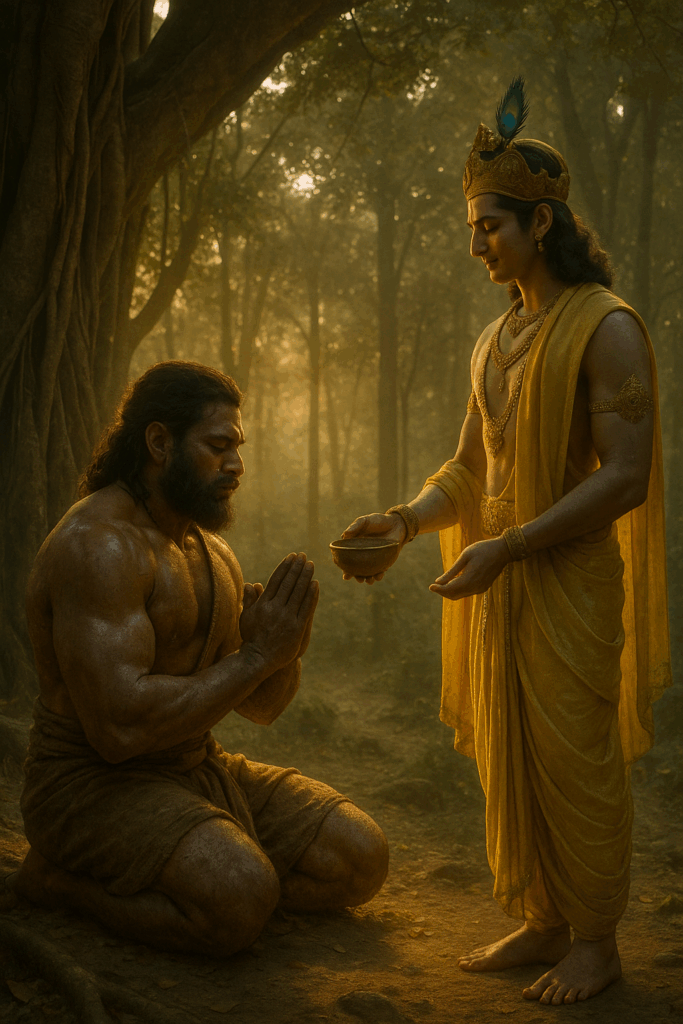
✨ Spiritual Context – The Story of Nirjala Ekadashi
Pandava Nirjala Ekadashi is perhaps the most austere and spiritually powerful of all the twenty-four Ekadashis in a year. It is also called Bhimaseni Ekadashi, and its sacred story is found in the Padma Purana, narrated by Vyasadeva to the mighty Pandava warrior, Bhima.
Unlike his brothers — Yudhishthira, Arjuna, Nakula, and Sahadeva — Bhima found it incredibly difficult to observe the twice-monthly Ekadashi fasts. Though devoted to Lord Krishna, he had an insatiable appetite and believed that fasting would weaken his strength, which was essential for protecting the kingdom and upholding dharma.
One day, Bhima humbly approached Sage Vyasadeva and confessed his inability to observe all the Ekadashis. He asked for a way to gain the same spiritual benefit without performing each individual fast. Vyasadeva advised him to observe just one Ekadashi each year — Nirjala Ekadashi, observed by not consuming food or water (nir-jala) for a full day and night.
The sage explained that the merit one attains from all other 23 Ekadashis is obtained by properly observing just this one day. However, he warned Bhima of the difficulty involved, as the fast required not even a drop of water.
Determined, Bhima undertook the Nirjala vrata with complete focus and austerity. He refrained from eating, drinking, or even rinsing his mouth. Though his body ached and he grew weak, his heart remained fixed on Krishna. The next day, Bhima completed the fast and broke it with devotion.
Lord Krishna, touched by Bhima’s sincerity and surrender, blessed him: “O Bhima, whoever observes this Nirjala Ekadashi with devotion shall be freed from all sins and attain the merit of observing all other Ekadashis. He shall not fear death or rebirth.”
Thus, this Ekadashi became known as Pandava Nirjala Ekadashi, the day of total surrender. It teaches us that Krishna values sincerity over quantity, and that even one day of focused devotion can lead to immense spiritual advancement.
For modern devotees, this day is a golden chance to practice detachment, mindfulness, and full absorption in Krishna consciousness. Whether one fasts strictly or not, the mood of surrender, humility, and devotion is the true offering that pleases the Lord.
📜 Importance Based on Scriptures
The Padma Purana and Skanda Purana extensively glorify Nirjala Ekadashi as the “king of all Ekadashis”. According to Vyasadeva, the benefits of all other Ekadashis — including freedom from sin, protection from evil, and entry into Vaikuntha — are obtained by observing just this one.
Bhima’s example teaches that even the strongest among us must bow to spiritual practice. Krishna Himself confirmed that those who observe Nirjala Ekadashi with devotion will be granted spiritual protection, freed from material contamination, and never suffer in the afterlife.
This Ekadashi is especially powerful in Kali Yuga, when regular spiritual discipline is hard to maintain. Those who can sincerely fast from food and water on this day receive immense spiritual credit, even if they miss other Ekadashis.
ISKCON teachings also stress that while the fast is tough, the essence lies in full remembrance of Krishna — through japa, kirtan, scriptural reading, and heartfelt prayer. The austerity purifies the body, while the focus purifies the soul.
For this reason, many devotees consider Pandava Nirjala Ekadashi a spiritual reset — an opportunity to go deep, surrender completely, and please Krishna with a heart full of dedication.
🛕 Rituals and Observance
The observance of Pandava Nirjala Ekadashi starts at sunrise on Ekadashi day and ends at sunrise the next day (Dwadashi). Devotees begin the day with a bath, preferably in sacred water, and resolve to follow the fast with sincerity.
This is a “nirjala” vrata — meaning no food, no water, and complete dedication for 24 hours. It is the most austere form of Ekadashi and is meant to be undertaken only by those who are physically capable. Children, elderly, pregnant women, and those with health issues may observe a water-only or fruit-only fast instead.
Devotees spend the day engaged in:
- Chanting extra rounds of the Hare Krishna Maha-mantra
- Hearing Krishna-katha from Bhagavad Gita, Srimad Bhagavatam, or Bhagavat Katha (Lectures)
- Avoiding idle talk, digital distractions, and negative thinking
- Offering lamps, incense, and Tulasi leaves to the Lord
Many temples hold kirtan and Jagaran (night vigil) on Nirjala Ekadashi to help devotees stay spiritually absorbed throughout.
While the fast is strict, the mood is joyful. Remember: it’s not about how much austerity you can bear, but how sincerely you offer your effort to Krishna.
🌍 Why This Ekadashi Matters in Kali Yuga
In the age of Kali, when spiritual laziness, doubt, and material distractions are rampant, Nirjala Ekadashi stands as a beacon of strength and surrender. It is a reminder that our spiritual life must be taken seriously — and that one day of full devotion can counteract lifetimes of karma.
Kali Yuga makes it difficult for most people to consistently observe all 24 Ekadashis. For those struggling, Pandava Nirjala Ekadashi provides an opportunity to gain the full benefit of the entire year’s vrata through just one sincere fast.
Bhima’s story reflects modern challenges — strong in body, weak in discipline. But his determination to please Krishna transformed him. In the same way, this Ekadashi invites us to step out of our comfort zone, offer something difficult to the Lord, and be transformed by grace.
Srila Prabhupada encouraged devotees to take Ekadashi seriously, and Nirjala Ekadashi especially, as a day to deep-cleanse the heart, break sinful habits, and re-ignite enthusiasm for bhakti.
This isn’t just a fast — it’s a total surrender, a sacred offering, and a bold declaration that “Krishna, You come first.” That surrender is what draws the Lord close — not perfection, but pure intent.
🧠 Scientific Reasoning
Although deeply spiritual, Nirjala Ekadashi fasting also brings significant health benefits — when approached mindfully.
Modern science supports the idea that intermittent dry fasting (no food or water) for 24 hours can activate deep autophagy, a process where the body clears out damaged cells and regenerates new ones. It may promote cell repair, immunity, brain clarity, and even anti-aging effects.
While difficult, dry fasting trains the body to be resilient. It improves metabolic health and can reduce dependency on frequent food intake. The mental clarity that emerges by the second half of a Nirjala fast is often surprising to first-timers.
From a yogic perspective, Nirjala fasting reduces tamas (inertia) and rajas (agitation) — allowing sattva (purity and focus) to rise. This sattvic state is ideal for chanting and meditating on Krishna’s names and form.
It also strengthens willpower, reinforcing the belief that “I am not this body.” That identity shift is central to bhakti.
That said, dry fasting is intense. Devotees should consult with a healthcare professional if unsure, and prioritize the mood of devotion over pushing physical limits.
The body benefits, the mind purifies, and the soul rejoices — this is the holistic magic of Nirjala Ekadashi.
🌅 Breaking the Fast on Dwadashi (8 June 2025)
After completing Nirjala Ekadashi, one must break the fast (Parana) during the correct Dwadashi time window. This act seals the spiritual benefits of the vrata.
✅ How to Break the Fast:
- Wake up early on Sunday, 8 June 2025
- Complete morning japa and prayers
- Offer grain-based prasadam (like kichdi, rice, or roti) to the Lord
- Break your fast within the Parana window
🕰️ Parana Timings:
| Location | Parana Start | Parana End |
|---|---|---|
| India (IST) | 05:41 AM | 07:20 AM |
| Australia (Melbourne) | 07:30 AM | 10:42 AM |
| New Zealand (NZST) | 07:28 AM | 10:42 AM |
Please avoid delaying the Parana or missing it, as it invalidates the fast’s merit. Even a small quantity of grain prasadam completes the vrat.
Offer gratitude to the Lord, drink water, rest, and allow the body to recover. Most importantly, carry the humility and inner strength gained into the weeks ahead.